Yuntong (Tianjin) Industrial Co., Ltd.
-
+8613682051821
-
sales@ytsmartcam.com

EN10219 and EN10210
Overview
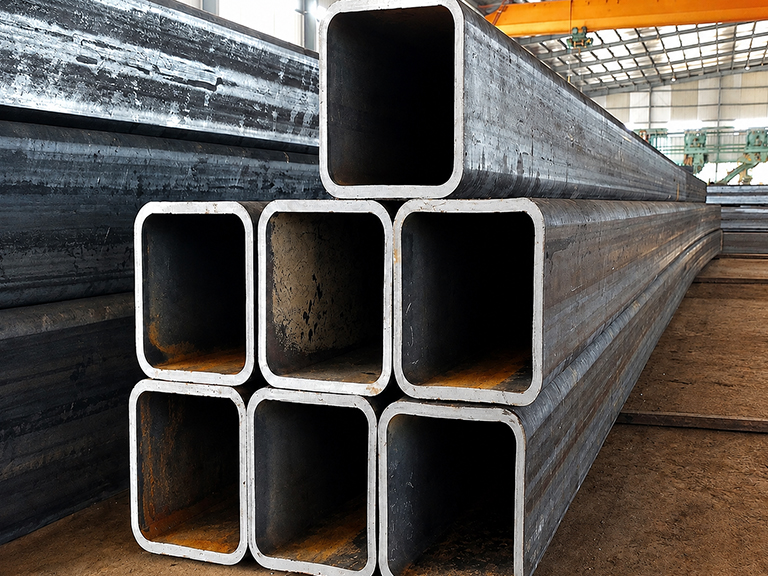
Both standards are published by CEN (European Committee for Standardization) and apply to structural hollow sections — covering SHS (Square), RHS (Rectangular), and CHS (Circular Hollow Sections). The critical dividing line is how the steel is formed.
EN 10210 — Hot-formed Structural Hollow Sections
Full title: EN 10210 — Hot finished structural hollow sections of non-alloy and fine grain steels
Manufacturing process:
The steel is heated above its recrystallization temperature (~900–1200 °C) and then formed into the hollow shape — either by hot extrusion or by hot forming a welded tube followed by a full heat treatment that normalises the weld zone. After forming, the section cools naturally to room temperature.
Key characteristics:
- Large corner radius — hot forming produces a generous rounded corner (typically 1.5× to 3× wall thickness), which is visually distinctive and beneficial for fatigue resistance.
- Uniform grain structure — because the entire section is formed above the recrystallization temperature, the steel grains are uniform throughout, including at the corners. No cold-working effects remain; the material is essentially stress-relieved.
- No residual stresses from forming — the hot process eliminates forming-induced locked-in stresses, which can be important for buckling resistance.
- Better ductility and toughness — hot-formed sections typically exhibit superior Charpy impact values at low temperatures.
- Seamless or fully normalised welded — EN 10210 can be either seamless (Part 1) or welded with full normalisation (Part 2).
Common steel grades: S235JRH, S275J0H, S355J2H, S420MH, S460NH (the “H” suffix denotes hollow sections).
EN 10219 — Cold-formed Structural Hollow Sections
Full title: EN 10219 — Cold formed welded structural hollow sections of non-alloy and fine grain steels
Manufacturing process:
A flat cold-rolled steel strip (coil) is progressively bent at room temperature through a series of forming rolls into a round, square, or rectangular shape. The longitudinal seam is then joined by ERW (Electric Resistance Welding). A final sizing pass brings the section to its exact dimensions. No post-weld heat treatment is required by the standard.
Key characteristics:
- Sharp corner radius — cold forming produces a much tighter corner (typically 1.0× to 2× wall thickness), giving a squarer, crisper appearance. This is one of the most visually obvious differences from EN 10210.
- Work-hardened corners — the plastic deformation at corners during roll-forming increases the yield strength locally (strain hardening), but also introduces residual stresses and may reduce ductility in the corner region.
- Residual stresses present — locked-in forming stresses may need to be accounted for in buckling design.
- More economical — cold forming is faster, uses less energy, and produces sections at a lower cost per tonne. EN 10219 sections dominate the market by volume.
- Tighter dimensional tolerances — cold-formed sections generally achieve better surface finish and dimensional accuracy.
Common steel grades: S235JRH, S275J0H, S355J2H, S420MH, S460MH.
Head-to-head comparison
| Aspect | EN 10210 Hot-formed | EN 10219 Cold-formed |
|---|---|---|
| Forming temperature | Above recrystallization (~900–1200 °C) | Room temperature |
| Corner radius | Large (soft, rounded) | Small (sharp, crisp) |
| Grain structure | Uniform, recrystallised | Elongated, work-hardened at corners |
| Residual stress | Essentially none | Present from forming |
| Ductility / toughness | Better | Adequate, but reduced at corners |
| Dimensional tolerance | Wider | Tighter |
| Surface finish | Mill finish (slightly rougher) | Better (from cold strip) |
| Cost | Higher (more energy, slower) | Lower (faster, less energy) |
| Typical use | Fatigue-critical, seismic, low-temp service | General construction, secondary members |
Design implications (Eurocode 3 / EN 1993-1-1)
Both standards are recognised by Eurocode 3 and use the same buckling curve classification. However, because EN 10210 is free of forming residual stresses, a design engineer can take advantage of:
- Slightly higher buckling resistance in some cases (especially for stocky columns).
- Better fatigue performance due to the smooth corner radius.
- Greater confidence in low-temperature toughness for outdoor or offshore applications.
For the vast majority of commercial and industrial buildings, EN 10219 cold-formed sections are perfectly adequate and are chosen for their cost advantage and availability.
In short: EN 10210 = hot-formed (large rounded corners, no residual stress, premium performance) and EN 10219 = cold-formed (sharp corners, more economical, dominant in the market). The choice comes down to whether the project’s mechanical demands — fatigue, low-temperature toughness, buckling sensitivity — justify the cost premium of hot-formed sections.
展示详情